
Croaked
By Ruth D’Alessandro, The Wildlife Gardener The Wildlife Gardener has amphibian anxiety. Last week, there were NO frogs in the Wildlife Pond. No croaking, no splashing, no churning. In previous years, frogspawn has arrived in the middle of February. The surface was millpond flat, and so was my mood. What has happened?
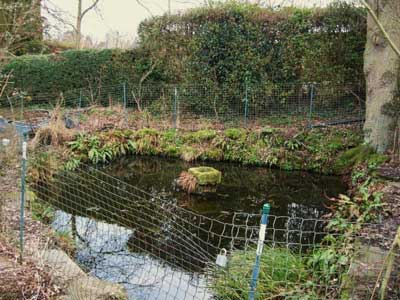
At first, I put this dearth of amphibians down to the prolonged, harsh winter. Perhaps the newts and frogs hadn’t ventured out of hibernation. That’s fine, they’ll wake up when the time is right. Then my friend in the next village told me that her little pond has 70 frogs in it, so many that it was overflowing and gelatinous with spawn and several female frogs had been drowned by amorous males. I didn’t want 70: fifteen would be enough, five even, but none? Dismayed, I chewed over several theories: 1. Pollution? The spring that feeds the Wildlife Pond comes down from the local golf course. The roads through the course had been salted during the snowy weather. Could salt have washed down into the pond and polluted it? How would I go about testing the pond water? 2. Predation? There was such a proliferation of dragonfly larvae last year that most tadpoles were eaten or maimed. I know a grass snake lives nearby. And those froglets that made it out may have been gobbled up by the hens. Could the foraging hens also have eaten the bugs, worms and slugs that the frogs rely on? However, those froglets would not yet be mature enough to breed this year, so where were their big cousins? 3. Heron? During the cold snap, a heron crashed through the ice and set up home in the pond. Could it have winkled out frogs hibernating in the leaves at the bottom?
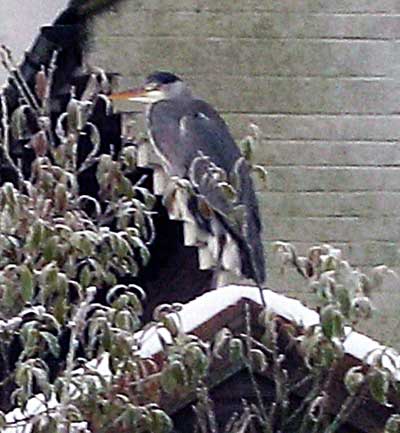
4. Housekeeping? I cleared out all the choking blanketweed last year , cut back the marginal plants and slubbed out some of the leaves. Perhaps the frogs preferred it messy. Yesterday being Saturday, I had the chance to have a good look in the pond. To my relief I saw three common newts swimming about, and I even heard the burping of a single male frog calling for females. Perhaps that rules out pollution. But my relief was short-lived with the grotesque sight of a male frog clinging to the bloated corpse of a female:
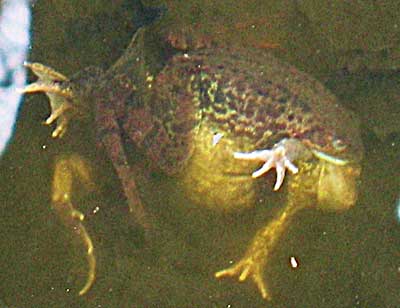
She’s not faking it, honestly…
Not exactly the fecund churning of previous years, and not boding well for frogspawn. Today, a warm, spring-tinged day and a little more pond activity ” two more adult frogs, but not attached to each other. The dead female is still embraced by what by now must be a rather puzzled male. When will he give up? When she starts to smell? When she’s a skeleton? At least there is some amphibian activity, but nowhere near the frogfest of previous years. Perhaps the party will kick off next week. I hope so. I love our frogs. I’ll keep you posted.
- Spurn Spawn! - 26th February, 2014
- Bluebells on wheels: axles of evil? - 2nd February, 2011
- Raising the ba: Wildlife and the Ancient Egyptian Book of the Dead - 8th January, 2011

The frog was bloated? I wonder how it ded.
Hi Corinne,
Yes, it is perfectly possible that the two male frogs drowned the female. This was happening in my pond http://naturenet.net/blogs/index.php/2010/03/25/not_croaked_after_all
so I fished out the tangle of mating amphibians and placed them in shallower water where the female could at least heep her nose above water. It doesn’t always work, though!
Yesterday in the pond there were two frogs clinging to a larger frog. One of them had his arms holding so tight round the larger frogs neck that it looked like it was being strangled. They stayed there all day draging the larger frog around the pond. Today the larger frog is floating around dead. I’m not sure why it died. Is there something i should do to help the frog if i see this again?
No worries! Ranavirus does tend to be cyclical, flaring up when there’s a frog population to support it. At least with a well-populated pond next door there should be a reasonable dispersing population to recolonise your pond sooner or later! 2009 was warm even when it was wet, and the early spring and late winter allowed a lot of species to do really well – I work mainly on lepidoptera and ladybirds, so haven’t seen the Odonata figures, but it would make sense that they did well, given the abundance of food for the adults, and also probably the summer rain for the last three years preventing ponds drying out as much
Thank you so much for this information, Richard. It has set my mind at rest regarding some of my concerns. I went to remove the dead frog but it had disappeared – perhaps the male had dragged it into a deeper bit. Newts and frogs coexisted quite happily in the last few years. Very interesting re 2009 being a good insect year – perhaps this would explain the explosion of Odonata nymphs.Ranavirus is my biggest worry, but I also understand that populations can be cyclical and we could be overrun with frogs in 2011!
I would suggest that predation is also unlikely – the newts in my pond have eaten every tadpole, despite my best efforts, for at least the last decade, and we still get plenty of frogspawn every year. The frogs also don’t seem to mind pond housekeeping, with no discernible difference before or after in terms of numbers, and I’d be very surprised if the hens can eat anywhere near enough invertebrates to starve the frogs, especially given the slug population explosion over the last 3 wet years, and the way that 2009 was such a great insect year. As for the salt theory, I’d have thought it would be long diluted by now – salt-tolerant species like Danish Scurvy-Grass only grow on the very edges of roads, etc, where the salt pollution is highest – I’d have thought it would be massively diluted by the time it reached your pond. I know that aquatic garden centres do testing kits for aquaria, though I’m not sure whether salt(s) are covered though. There’s always the spectres of ranavirus and the chytrid fungus lurking in the background, especially if you have a dead frog in the pond – more info is on the Froglife webpages, but rather hidden.
Hope they come back soon!
I hope the next instalment will be more positive, ghostmoth…:-(
I look forward to the next instalment. I don’t think male frogs are the brightest of creatures …