
Slovenian bee houses – not as crazy as they look.

- Complaining about the Mainland - 17th August, 2024
- New island designation – is it just greenwash? - 26th April, 2024
- Police and Crime Commissioners – a solution or a problem? - 21st April, 2024
The Ranger’s correspondent Dave Larkin writes again, with even more remarkable imagery. This time, instead of salted pigeons, Slovenian bees are the object of his attention. He writes:
On the continuing breadcrumb trail the woodcut reminded me of a bee board (front to a bee hive decorated with folk scenes) I saw in Slovenia showing a young man fishing in a river of bathing women with a pair of trousers (on the basis that the women want to wear the trousers). Unfortunately I didn’t get a photo of this, but did find a very nice bee house in Solčavsko.
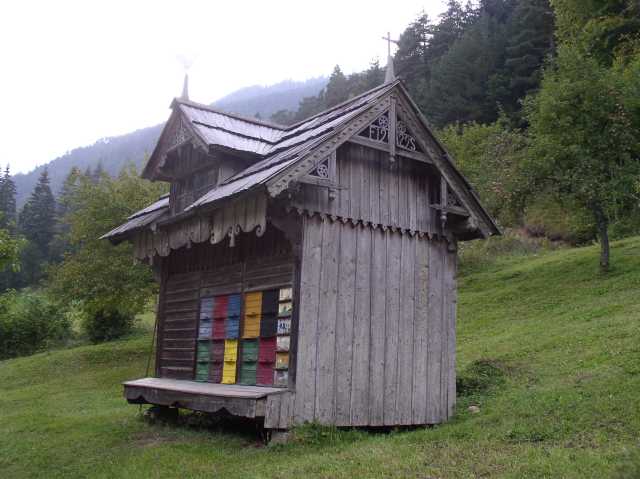
A bee house? Whatever is that? The Ranger did a bit of bee-keeping whilst at college, but never learnt of this distinctively Slovenian tradition. Slovenia has a very long-standing bee-keeping heritage, and even its own strain of bee. Franc Šivic, vice-president of the Bee-keepers’ Association of Slovenia explains about the houses:
Slovenian bee-houses are unique phenomenon with their high roofs and special forms, which express a particular care and liking for the bees of our beekeepers… …the reasons [for using these houses] were extremely demanding and quickly changeable climate conditions, short, although sometimes abundant pastures, relief features, small space, tradition, necessity of transports to pastures and other reasons.
So these are mobile huts which are used to move bee colonies from pasture to pasture – an important ability when the season could be quite short, as is often the case on upland pastures. Other beekeepers, too, often move hives around – but rarely in such delightful style. Perhaps the most charming feature of these very practical constructions is the decoration – the Ranger notes that Franc Šivic does not try to explain those in terms of necessity, although actually, he could have. See this detail that Dave provides:
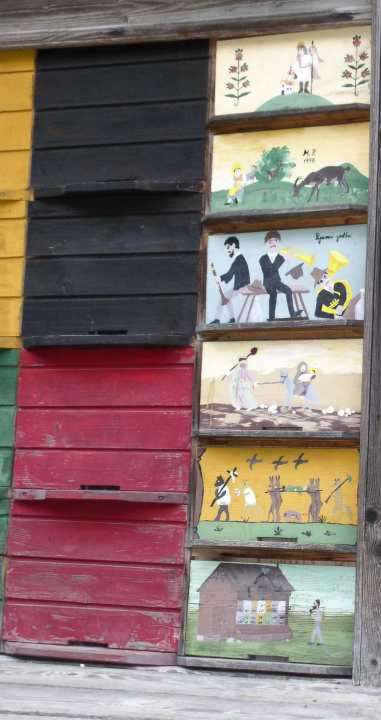
On the left of the pictures can be seen a stack of four hives – each little board has a long hole above it where the bees will enter. Each hive is a separate colony, and if you look carefully, you’ll see that each of the charming painted pictures is also a separate hive – six of them in that stack. Presumably the pictures also serve a very practical purpose. One of the problems with moving hives around is that the bees need to be able to find their home again when the hive is relocated. Bees do this by imprinting on their home visually, before they begin their flight. You can see them do this when they first emerge – they buzz around and look at the hive. Each hive has its own colour and illustration. So it will be very helpful for the bees to have very distinctive colours near their own hive, preferably bright, contrasting colours… and lo and behold, this is what the traditional Slovenian bee house provides. You looked at the picture and thought it was a cute bit of antiquated nonsense, didn’t you? Think again. The Ranger wonders if anyone can provide a similar rational explanation for the gothic woodwork..? UPDATE: see more about Slovenian bee-houses here

I am a Artisan Bee Hive Builder from the San Antonio area And as far as I know I am one of three People either selling or Building AZ Style Hives here in the US. I designed the AZ Hives that i Build to Use the Commonly Available Langstroth Deep foundation. Why Use the Langstroth Deep Foundation, Because it is commonly available from multiple suppliers across
the USA and the frames will work in your current Deep sized Extractors.
The twin benefits of not lifting 80lb Honey Supers and not disrupting the whole hive were what prompted me to do this. And it has become my favorite Style of Hive. If you would like more Info email me at Steve4bees@gmail.com or visit my steve4bees page on Facebook.
This is a link to a PDF about my Hives: https://www.facebook.com/Steve4Bees/posts/1432614783488826
I’d be very interested in these types of hives but it’s sad though that some of us want to learn new ways but people are trying to sell those ways to us here in the US. We live in a society where information is abundant and for the most part free-flowing. I can get my own frames…etc. and build my own Langstroth hive but I have to pay to get an AZ hive made. I’m sorry but that is someone trying to profit off the Slovenian people by trying to be exclusive. If the whole purpose is to diversify things and create better ways for bee colonies to not only survive but thrive – then it’s beneficial to all of us to be more open about information. Beekeeping is my hobby…not my business and I’m more than willing to help people starting out…etc.
Through history there are things that make life better or are just improvements like computers, don’t you think those who make them are making a fortune and at the expense of the tiny pay that the Chinese people are making, doesn’t seem to be in issue there! The Slovene people have been doing the AZ hives longer than we have been doing Langstroth so its not a new thing just a new thing here. Actually, I have received a few emails about people living here in the states who grandparents kept bees this way, right here in the US. Somehow it got lost. These hives are not for everyone. If you are a beekeeper and buying Langstroth hives, I doubt you bought them at no cost or no profit to the manufacturers. People are in business to provide a service and make money. Trust me, we are not rolling in the $$, we just know that these types of hives make beekeeping possible for thousands of people who otherwise could not continue to keep on beekeeping or to start beekeeping. We have received many emails from people with disabilities who could in know way do the Langstroth with the lifting. People who do not have upper body strength and especially all the baby boomers getting older who can no longer pick them up or have back issues. The emails we get are amazing, one woman who has muscular dystophy was thrilled to find these as now she can continue to be a beekeeper even though she is now in a wheelchair. Or the man in NY who has a son and 2 grandsons with Autism who could never do the Langs but can do the AZ Hives. The stories are endless with the positive comments about this style of beekeeping. Beekeeping is also my hobby, I am 56 and I am so looking forward to next year to never lifting again. I am having a bee house built now. We do presentations to many bee clubs and the first thing people say is “this makes perfect sense, why are we not doing this here” or “no lifting and the bees are better protected, why are we not doing this here!” And by the way, we are providing work for the Slovene people where the unemployment rate is 35%, I know for a fact they are happy to be getting the business! But I will ask them next month when I am at the factory 🙂
I am not a beekeeper as both my wife and I are alergic to stings, but I do have an observation.
It is too bad that we in this country already know everthing. If we didn’t we might learn a few things from older cultures such as the Slovenians.
I have started a compnay slovenianbeekeeping.com We are importing these wonderful AZ hives and also organize Beekeeping Tours to Slovenia. I agree, the new is not always the best!
The biannual world beekeeping conference “Apimondia” was held in Slovenia in 2003. At the time there were a lot of pictures circulating of these delightful beehouses. Many were mobile setups drawn by horses. There are a number of good websites for Slovenian beekeepers for those interested in this style of beekeeping. The next Apimondia is in 2009 at Montpellier,France.
Local Hampshire beekeeping friends always move their bees from place to place during the summer ending up in the New Forest (for which they pay a licence fee). They use a Landrover as hive hauler – how are the Slovenian bee houses moved ? they look pretty solid articles for man/woman power haulage ….pause for thought…obviously a tractor and trailer is the answer.
Hello, In Slovenia they have many ways to move the hives, they have bee buses, bee truck, bee tractor trailer trucks and platforms and these can all be moved. You can check out my website where we sell the AZ Slovene hives and offer Beekeeping Tours to Slovenia. http://www.slovenianbeekeeping.com
Hello, The Slovenian bee houses are not moved but the bee buses, trucks and platforms are. Beekeepers there move their bees around to obtain different honey, not for pollination. There are about 10,000 beekeepers there and the country is the size of NH! If you would like me to send you some pictures of how they do move them, email me at beeslovenia@gmail.com
Suzanne Brouillette
Slovenian Beekeeping, Harrisville, NH
Saw an article about this over on organic life. Do you guys by chance also sell the plans for this type of hive?
Hi Josh, there are no blue prints of the AZ hive that any one has found so far. I sell the hives in tact if you are interested, email beeslovenia@gmail.com.
Thank you,
Suzanne Brouillette
Slovenian Beekeeping
Josh if you are still in the Market for AZ hives please send me a Email at Steve4bees@gmail.com or visit my steve4bees page on Facebook.
This is a link to a PDF about my Hives: https://www.facebook.com/Steve4Bees/posts/1432614783488826