Balloons – how they kill wildlife, and what to do about it

- Complaining about the Mainland - 17th August, 2024
- New island designation – is it just greenwash? - 26th April, 2024
- Police and Crime Commissioners – a solution or a problem? - 21st April, 2024
What happens to balloons after they are released? So asks the Marine Conservation Society in their campaign leaflet called ‘Don’t Let Go‘! It includes the answer: some sad pictures of turtles and seabirds killed by balloons which have drifted down to earth and ended up in the sea, and the stark message that balloons can kill wildlife. The problem is also getting worse – WDCS survey and clear beaches, and report an increase in balloon litter since 1996. MCS say:
Balloon litter floating at sea is deadly for many marine wildlife species. Marine turtles and some seabirds are particularly at risk, as they feed on prey that floats at the surface. They may mistake floating balloons for their jellyfish prey and swallow them, or become entangled and drown. Once swallowed, a balloon may block the digestive tract and eventually lead to death by starvation. Some whales, dolphins and fish are also known to have died as a result of eating balloons. Once balloons are out of sight, they don’t disappear – what goes up must come down! An estimated 90-95% of released balloons rise to an altitude of 5 miles where the temperature and pressure is such that they burst into small fragments. The remaining 5-10% that do not reach a high enough altitude may remain inflated and can float many miles before descending back to the land or the sea semi-inflated.
MCS are campaigning, with moderate success, for a voluntary and legislative ban on mass balloon releases. They rightly say “Mass releases are potent symbols of our wasteful and ‘throw away’ society“. They also, helpfully, provide some entertaining alternative ideas for fun with balloons, which do not involve releasing them. A ‘Prize Balloon Popping Competition’ sounds like fun! The Ranger agrees with this campaign. Additionally, the damned things end up all over the place, not just at sea. When The Ranger worked right out in the sticks at Wicken Fen NNR he regularly had the task of picking drifting balloon debris from the waterways and bushes. Any arable farmer upwind of any conurbation will tell you the same story. The nylon strings are the worst – they get tangled around stuff and just can’t be released.
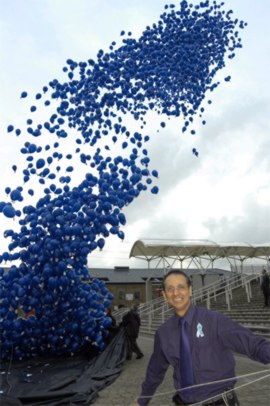
Anyway, what is it with balloon releases? Surely balloons are more fun to play with? Why let them go at all? Look at the smug corporate git in the picture above. The Ranger has no idea what this balloon release is about but it seems unlikely that it is a joyful celebration of life and love – more likely the opening of some mobile phone shop. There are two people watching, and they look bored to tears. Balloon releases are so banal and commonplace that they are not really that exciting any more. No, not even if you release a million of them. So stop it.

It’s amazing the things we do without thinking. I had balloons released when Izzy was 1 for a naming ceremony – wishes for her life were attached. I really loved the sentiment but having read this I would never have done it. I will think more about the consequences of my actions – thanks for raising awareness.
I didn’t know this. I knew about the bird feed mesh (as I have highlighted in my blog)and about the plastic that holds beer cans together.
Thanks for raising this.